Outdoor Industries Feeling the Heat from Climate Change
<p>The Outdoor Industry Association (OIA), a trade group representing more than 4,000 manufacturers, retailers, distributors and adventure companies, recently joined the business coalition BICEP to push for passage of comprehensive climate and energy legislation. These companies recognize that investing in clean energy and halting our addiction to emitting carbon pollution for free isn’t just good environmental stewardship, but also good economic policy.</p>
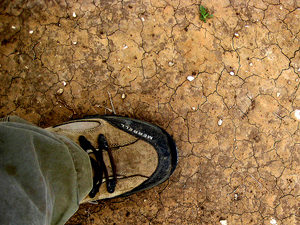
Image CC licensed by Flickr user slopjop
It’s July 4th weekend in 2025, and you’re an outdoors lover looking to go rafting and trout fishing in the national park formerly known as Glacier.
The only problem, in the midst of the longest drought on record, is that many rivers in Montana -- as well as the rest of the Northwest -- are drying up, and trout can't survive the ever-warmer water.
Oh well, how about a hike instead? That’s off the table, too -- wildfires and pine-bark beetles have ravaged the parched region for years, so now many of those trails on your old map are eroded and dangerous.
This is far from fantasy: Outdoor pursuits will be among the first activities widely altered by climate change. And now, many of the $730 billion outdoor industry’s largest companies are getting vocal about it.
The Outdoor Industry Association (OIA), a trade group representing more than 4,000 manufacturers, retailers, distributors and adventure companies, recently joined the business coalition Business for Innovative Climate & Energy Policy (BICEP). BICEP’S goal? Passage of comprehensive climate and energy legislation.
The danger is imminent, says OIA President Frank Hugelmyer.
”Healthy public lands that support the nation’s $730 billion outdoor recreation economy are imperiled by a warming climate,” he says. “The outdoor recreation industry and those who pursue outdoor activities are among the first to experience the impacts of climate change on our public lands. We believe our industry is in a unique position and has a responsibility to offer leadership on this important issue.”
The OIA includes widely recognized consumer brands such as REI, Patagonia, The North Face and Levi Strauss, recreation/conservation groups like the Appalachian Mountain Club and the Audubon Society, and outdoor adventure companies Field and Stream, Outward Bound and the National Outdoor Leadership School.
These companies recognize that investing in clean energy and halting our addiction to emitting carbon pollution for free isn’t just good environmental stewardship, but also good economic policy. They recognize that what some in Congress want -- an energy-only bill that gives us the tasty ‘dessert’ of renewable energy subsidies without the desperately-needed ‘vegetables’ of carbon emission limits -- risks sending American clean energy jobs and innovation overseas to countries that do both. That’s because businesses crave the market certainty of a price on carbon, which levels the playing field for alternative energy investments.
“Today, perhaps more than ever, we in business need to establish a new level of leadership in sustainability,” said Levi Strauss & Co. CEO John Anderson in a recent speech. “We need a more rigorous and systematic way of illustrating the problem, and solving it. If sustainability in business slips into a few well-worn clichés and corporate slogans, then I think we are failing in our role as business leaders.”
And we’ll be failing our businesses themselves, by the way: Leave our intrepid rafter/hiker with no place in Montana to pursue her passions, and we’re also killing that state’s fifth-largest industry, which provides 45,000 jobs. Similar impacts await in places from Florida to New Hampshire to Colorado, where outdoor businesspeople will tell you they’d cut into the economy even more deeply.
The outdoor industry holds one of the unique, canary-in-the-coalmine places in this debate: It isn’t just that its bottom line is more directly sensitive to climate change than many other businesses. It’s the simple fact that the health of our outdoor systems is an important barometer of global environmental health. And as we are already seeing, painfully, in the Gulf, when ecosystems come under severe attack the emotional health of entire regions experiences severe stress with it.
The growing support for strong energy and climate legislation spans the American business spectrum. It isn’t just outdoor industries or BICEP: The U.S. Climate Action Partnership, We Can Lead, The Business Council for Sustainable Energy, American Clean Energy Innovation Council and American Businesses for Clean Energy (which alone represents more than 3,000 companies) are ALL pushing for strong, comprehensive legislation.
A U.S. Geological Survey predicts that Glacier National Park will lose all of its glaciers by 2020. The U.S. Global Change Research Program says winters in the northern U.S. now arrive 10 to 14 days later than they did a mere 20 years ago. The proportion of wintertime precipitation falling as snow has declined by 23 percent in the Northeast since 1949.
Scientific projections point to dramatically decreased snowfall across the United States in the coming years. A study by Southwick Associates estimated Northeastern ski areas would see a 25 percent to 45 percent decline in their ski season by the 2070s. A report by the Rocky Mountain Climate Organization found that the Colorado River basin should expect 30 percent less snowpack by 2040 to 2069, and Colombia River basin should expect 35 percent less by 2050.
Continuing inaction on our energy and climate challenge is not an option. The costs of acting are dwarfed by the costs of ignoring or denying these threats. It’s time for America and our leaders in Congress to wake up and respond to this challenge today -- and not next year.
This article originally appeared at the Huffington Post and is reprinted with permission. Mindy S. Lubber is president of Ceres, a coalition of investors, environmental groups and other public interest organizations working with companies to address sustainability challenges such as global climate change.