
[Editor's note: Thanks to all the comments and feedback on this version of the CSR mind map, Perry Goldschein has created v 2.0 of the map, published on GreenBiz.com.]
To all but the most grizzled veterans, corporate sustainability and responsibility continues to evolve into an increasingly complex, hard-to-grasp realm of processes, organizations, stakeholders, reporting, standards, certifications, laws, regulations and more. While it's often not necessary to understand all of the variations each of these play for a specific company's efforts, it is helpful to understand the big picture in making the best decisions related to CSR efforts.
That's why I thought I'd take a crack at the first CSR mind map that I'm aware of that encompasses the major concepts for U.S.-based CSR executives. It's designed to fit on a single, typical computer screen or standard 8.5 x 11 inch page while remaining legible, thereby providing the big CSR picture at a glance. Think of it as a "back-pocket" road map that helps you piece together the CSR puzzle and make connections between various steps and aspects of the process. The red arrow illustrates one those connections explicitly (e.g., from CSR reporting under "Organizational Processes" to the "Major Reporting Standards").
Click on the detail image below to see the full-sized CSR mind map.
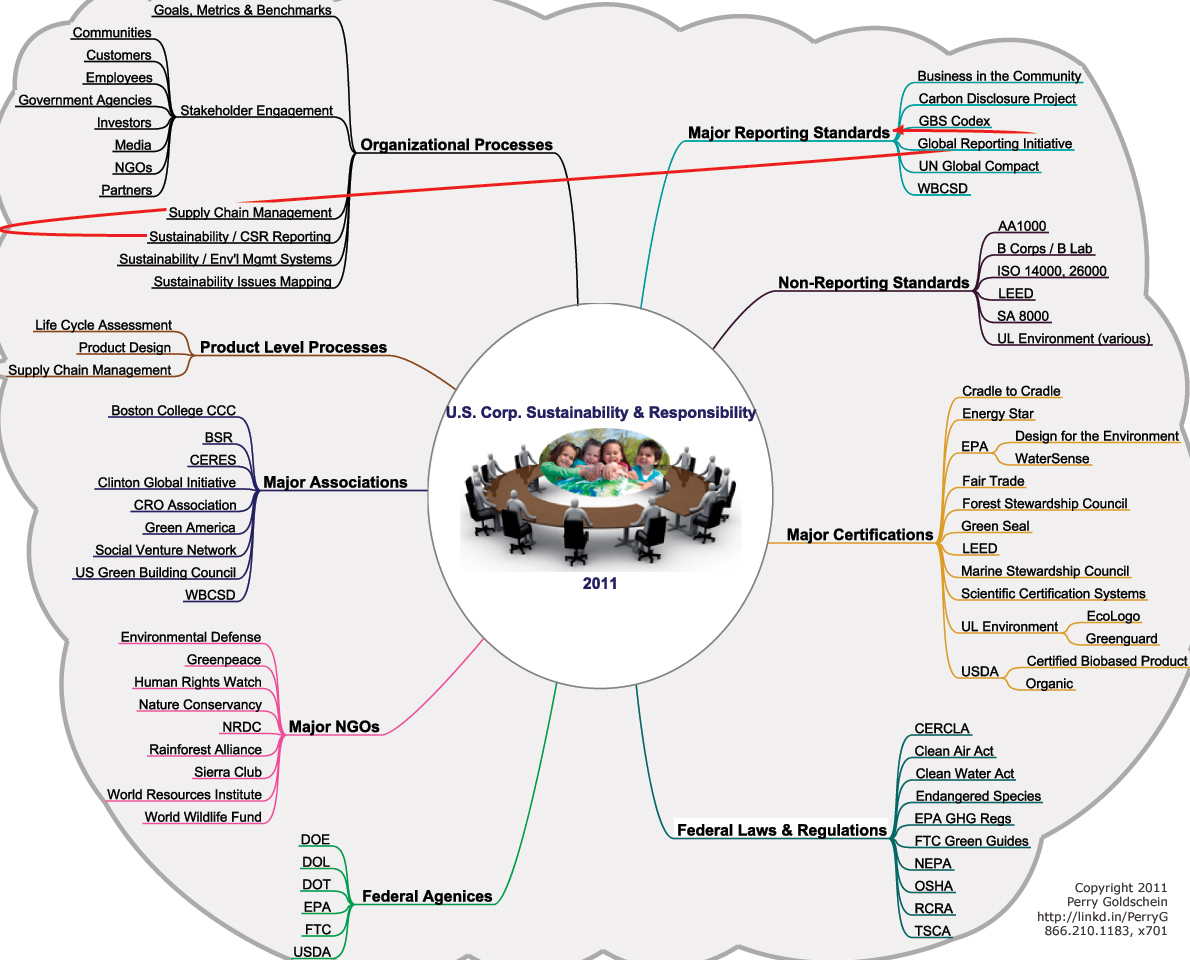
The mind map is far from comprehensive by design, and is meant simply to provide many of the most critical pieces of information for each of the major aspects of CSR best practices in an easily digestible way:
• since critical elements of CSR take place differently at the corporate and brand /product levels, the map breaks out both organizational and product-level CSR processes;
• standards are broken out by reporting and nonreporting, especially since reporting is probably the most common element tying CSR together across different industry verticals;
• major CSR associations, as well as NGOs and federal government agencies are relatively few, easily identifiable, and among the most important sources of information and stakeholders; and
• while CSR-related laws and regulations provide the minimum base from which best-in-class CSR programs expand, major certifications are important for helping organizations go beyond minimum compliance, and in gaining credibility and market awareness.
I hope this mind map proves helpful in planning, review and communication of your CSR efforts. Since this is only a first draft, please do let me know if it's helpful and how you think I can improve future versions. Please comment on this post or email tips@greenbiz.com. I would specifically be interested in feedback on whether it would be useful to have more information on additional pages, with separate mind maps, for concepts such as certifications, for example, where literally hundreds exist in dozens of categories; and any thoughts on how existing information can be more accurately classified.
Thanks to Susan McPherson of Fenton Communications and Ellen Weinreb of Sustainability Recruiting for their valuable input.
Map photo CC-licensed by Changhua Coast Conservation Action.


Thanks, Perry. This CSR mind
Thanks, Perry. This CSR mind map is the first of its kind that I've ever come across. That in and of itself makes it an important contribution to the field!
Your diagram is extremely robust and comprehensive, which is difficult to accomplish given the moving target of forces and players. Based on your other comments, it sounds like you've already been making updates and I imagine that will be an ongoing process. But I think you've created the baseline for an important CSR management tool.
My company has been working on a CSR value model, which I introduced in a blog here: http://www.thinkactshare.com/green/greening-for-survival. It partially overlaps with the CSR mind map's organizational processes section.
Thanks again for sharing,
Ashok
I offer you my services with
I offer you my services with a desire to help the environment and the company's bottom line. Joe Valdez Regional Sales Executive at Earth, Wind and Solar, LLC. joefloor@hotmail.com
Hi Perry. Thanks for the
Hi Perry. Thanks for the mind map. It makes the enormous realm corporate sustainability and responsibility digestible.
There may be an opportunity to identify more explicit connections between sections in the mid map. I agree with Adrea’s comments above that creating shared value (i.e., simultaneously advancing economic, social and environmental conditions for all stakeholders through changes in operating processes and policies) is the end game. As such, stakeholder engagement will have a direct influence on, not only organizational process, but product/service processes as well. By addressing the needs of all stakeholders through changes in operational and product processes, a company can find fuel for innovation, open new markets, reduce risk and gain a competitive advantage. Perhaps a red line should be drawn from ‘Stakeholder Engagement’ to 'Product Level Processes' to show this explicit connection?
Thanks Perry, I love this
Thanks Perry, I love this map. It can be very useful as an educational tool for clients to understand the connections that sustainability/CSR professionals know inherently---but can really benefit from referring to a picture! I can imagine showing clients an array of options with regard to sustainability certifications to discuss the differences, pros, and cons of each one and where they fit in the scheme of things. Perhaps this map will help organizations to see that certifications are only one small part of the equation (although a great start and easy to latch on to!) of what can be a much larger, more comprehensive strategy.
A technical comment/question:
Are the UN Global Compact and the WBCSD actually considered "major reporting standards." If yes, I am curious how so. Should organization be reporting off of how they approach the values in the Compact, for example? I would think that WBCSD would fall under the "Major NGO Category."
Hi Perry, thanks for
Hi Perry, thanks for attempting a Herculean task. It's no simple thing to summarize over thirty years' evolution in a complex, systemic subject area! Certainly worthwhile giving it a go, however, and it makes for interesting reading.
A couple of top-of-mind reactions for further areas to incorporate:
1. global nature of sustainability challenges - many of the greatest wins have come about through international agreements (think CFCs/ozone layer, and the role of UN specialized agencies like ILO, special advisors, etc.) - also best practice tends to osmose over time from one region to another (e.g. EU policy). It's hard to draw a national boundary around it.
2. strategy & innovation - leading companies are now seeing sustainability as core to future business success - and re-engineering the business around an ambition to create shared value with zero impact. This is the end game, other aspects like reporting, EMS, etc. are tools/means to that end.
3. drivers - it would be helpful to add an overview of the major drivers and megatrends that are taking sustainability centre stage for business (e.g. globalisation, population growth, resource scarcity, pollutant loadings, trust & transparency revolution, etc.)
4. ethics & governance - a major development in past few years has been 'responsible business practice' and ethical conduct (e.g. Sullivan principles, Turnbull report)
5. role of scientific/research community (e.g. IPCC) and industry associations/voluntary agreements (think 'responsible care' in chemical industry - have been key in putting issues on the table. New issues coming up from NGOs in other fields, e.g. health, poverty, etc.
This is by no means comprehensive - but hopefully some help in taking your project forward.
Cheers,
Andrea Spencer-Cooke
I wanted to let readers know
I wanted to let readers know that since the version of the mind map included here, I had substantial and valuable input from Bob Pojasek of Capaccio Environmental, who also teaches at Harvard. A big additional thank you to Bob. If you would like a copy of the updated version, please submit your request via the email link in the second to last paragraph of the post ("tips|at|greenbiz|dot|com").