Bank of America's $50B green initiative: Mighty or misplaced?
<p>Critics say the goals are a step in the right direction, but the bank's priorities could be better invested elsewhere.</p>

Bank of America recently announced a 10-year goal to put $50 billion towards renewable energy projects, energy efficiency and alternative transportation – a move the bank says will help grow the economy and its own business as well. But critics say the bank could make a greater impact by cutting off the billions it invests in coal each year.
Scheduled to become effective on Jan. 1, 2013, the initiative will be implemented through lending, equipment financing, capital market activities, carbon finance and investment solutions – services which the bank says are needed by its customers.
“Many of our clients are transitioning to more environmentally conscious business practices, products and services,” said Cathy Bessant, Global Technology and Operations executive and chair of Bank of America’s Environmental Council. “We can continue to grow our business, promote a greener global economy and address climate change by helping our clients meet their own sustainability objectives.”
But vocal critic Rainforest Action Network says that though the initiative is a step in the right direction, the bank’s approach is missing the point.
"The bottom line is we cannot reduce the emissions necessary to stem climate change with renewable energy funding alone,” RAN's director of energy and finance Amanda Starbuck said in a statement.
According to the organization, Bank of America has provided $6.4 billion towards coal in 2010 and 2011 -- more than any other US bank. RAN would like to see Bank of America cut off its coal underwriting activities entirely.
“We must also curb our use of coal, and Bank of America's new environmental initiative makes no move to do that," Starbuck said.
Photo of SolarStrong project located at Hickam Communities military housing, Joint Base Pearl Harbor in Hawaii provided via Lend Lease
Alex Liftman, global environmental executive for Bank of America, addressed the criticism by saying the financial services industry is not the only sector that bears responsibility for reducing the economy's dependence on coal.
"The issue of coal is a global one issue, not a bank issue. … For this transition to take place, all of society needs to make this a priority," Liftman said.
"There is an expectation that the financial sector play a key role in ensuring that global markets account for environmental and social risks and impacts," said Mindy Lubber, president and CEO of sustainable business advocacy group Ceres, in an email. "Bank of America's leadership program is moving in exactly the right direction by showing that what is good for the planet is also good for business."
The $50 billion that Bank of America plans to spend by 2023 on coal alternatives is mind-boggling. There are four primary focuses:
- Energy efficiency projects for residential, commercial and public properties
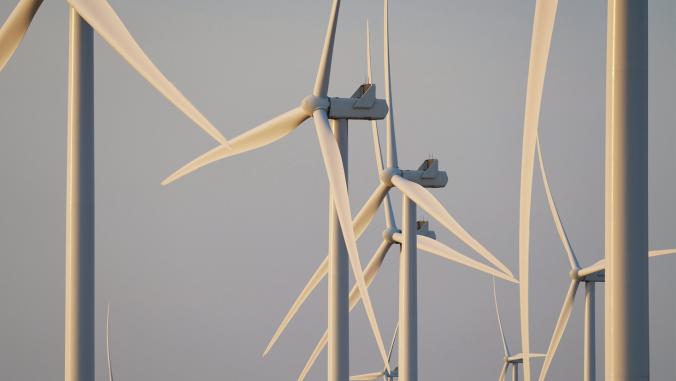
- Renewable energy projects including wind, solar, hydro, biomass and waste-to-energy solutions
- Alternative transportation technologies including electric and hybrid electric vehicles and the components and charging infrastructure to run them
- Innovative technologies for water purification and waste management
Bank of America says that it chooses these projects using the same rigorous criteria for returns that it expects out of any investment.
"These are all solid business deals," Liftman said. "This isn't philanthropy."
As of March 31, 2012, Bank of America had committed $17.9 billion to projects of this nature. Some examples include:
- $8.4 billion for energy efficiency, including $55 million dedicated to loans and grants for retrofits in low-income neighborhoods
- $5 billion on renewable energy projects. In 2011, the company arranged the financing for the world's two largest rooftop solar projects (including the SolarStrong military housing project, which almost collapsed when the federal government backed out)
- Close to $1 billion for consumer financing related to hybrid vehicle purchases
Aside from the $50 billion investment commitment, Bank of America is also planning $100 million in grants and investments for non-profits and community projects. For example, it is working with the U.S. Green Building Council to help ensure that LEED certifications can be earned on low-income housing, Liftman said.
The bank also announced several new green operations goals, including a 25 percent reduction in energy consumption by 2015 (compared with a 2004 baseline); a 20 percent cut in paper usage and water consumption (compared with its use in 2010); and a 70 percent diversion of global waste from landfill.
Bank of America's latest environmental declarations come on the heels of a $30 billion commitment by Wells Fargo in April 2012. The pledge also included a goal to give away $100 million in grants.
At the time of its announcement, Wells Fargo already had invested approximately $11.7 billion in projects akin to those being targeted by Bank of America: energy efficiency retrofits, wind and solar energy projects and public financing with an emphasis on environmental responsibility.
Although it has said less about the matter than its competitors, J.P. Morgan Chase has also been investing in alternative energy projects, which it considers "an attractive investment opportunity" for both the bank and its clients.
Since 2003, J.P. Morgan has invested $3.8 billion of its own money and $3.9 billion raised from co-investors in 95 renewable energy projects. Its primary focus has been on wind (farms financed by J.P. Morgan generated about 17 percent of the wind energy capacity in the United States at 7,600 megawatts). The bank has also backed 13 solar projects and four geothermal power plants.